Category: Musings

  • Let Me Call My Wife

    It started with biryani.

    Memorial Day weekend. A friend’s wife had gone to India a few days earlier, leaving behind an empty house that quietly volunteered itself as the venue for the evening. One friend cooked. He arrived with a pot of chicken biryani, fragrant and unhurried, sprinkled with fried onions on top and dried raisins hidden inside. Not a few raisins in one corner. Everywhere. You could not escape one in any bite, and you did not want to. The moment you bit into one, the juice would infuse into your mouth. Sweet, unexpected, perfect.

    After the first bite, chicken, raisin, rice, spices all arriving at once, someone asked the inevitable question. Do you have any pickle?

    Our host thought about it. Then picked up his phone and called his wife. She was 12.5 hours ahead, somewhere in the middle of her afternoon in India, and she answered. No pickle in the house. Our host reported back. We accepted this.

    The biryani ran out. The friend who cooked went back to his own home for more, and returned with something better than store-bought, a homemade lime pickle. We opened it, and immediately the next question formed itself. Do you have pappadam?

    Our host called his wife. She answered. No pappadam either. Another friend knew he had some at his place, went and got it.

    Now we had biryani, homemade lime pickle, and pappadam. Which meant only one thing was missing. You have to be a Malayali to understand the specific joy of a boiled egg with biryani, pickle and pappadam. It is not a combination you explain. You just know.

    Someone asked about eggs. Our host reached for his phone.

    The table revolted. Hands went up. No. Don’t. Put it down. Find out yourself.

    Our host looked genuinely lost for a moment, a man standing in his own kitchen, not knowing what it contained.

    Our host found the eggs in the fridge. They were there all along.

    And that was the evening. Biryani, lime pickle fetched from one home, pappadam fetched from another, eggs found after a small intervention. His kitchen contributed almost nothing to its own party. Not because he is a bad host. Just because the person who knew where everything was kept was 12.5 hours away, and he called his wife every time without hesitation. And every time, she answered.

    We laughed about it that night. It was funny. It still is.

    But somewhere on the way home I kept thinking about it. About how completely we can live inside a life that someone else quietly organizes around us. The pickle, the pappadam, the location of eggs in our own fridge. We don’t notice any of it until it’s gone.

    We are more dependent on our spouses than we will ever admit. Most of us just haven’t had a Memorial Day party to prove it.
  • Art Is Not a Debate

    A few years ago I was in the UK watching a film that audiences widely loved. I was enjoying it thoroughly. During the interval I heard a couple of people nearby tearing it apart. Completely dismissing it. And I remember feeling a mild surprise, not because they disliked it, but because there was no curiosity in the dismissal. No question of why the filmmaker made the choices they made. Just a verdict.

    That is where I think we go wrong with art. Disliking something is perfectly fine. Personal taste is personal. What I like you may not like and there is nothing to debate there. But there is a difference between not liking something and not trying to understand why it was made. The second one is a closed door. The first one is just preference.

    This comes back to me every time I think about something a friend said after visiting museums in Holland. He came back and said that Raja Ravi Varma’s paintings are better than Van Gogh and the only reason Van Gogh is so famous is because nobody is promoting Raja Ravi Varma. I am not sure why my friend felt the way he did. I have seen a couple of Van Gogh paintings myself and I liked them. But I am no art connoisseur. I cannot tell you why one painting is greater than another. What I do know is that my friend was not wrong to feel what he felt. And I was not wrong to feel what I felt. We were just standing in different places looking at the same wall.

    That is the thing about any art form. The question worth asking is never whether you liked it. The question worth asking is why someone made it, and why it moves certain people the way it does. You do not have to change your opinion at the end of that inquiry. But you will almost certainly come out of it a little more interesting than when you went in.

  • Third Prize, No Posts

    A friend’s daughter won third place at a science exhibition last week. Smart kid, good result, proud parents, and one firm condition: nothing on social media.

    Her parents are not the type to flood your feed. They post occasionally, the way most people my age do. A trip here, a family moment there. Something worth sharing with people who actually know them. So when their daughter won, the instinct was there. But the condition held.

    I found this oddly moving.

    Think about how we grew up. Our parents didn’t announce our achievements either, but that wasn’t a philosophy. There was no platform, no audience waiting, no little heart button to press. Pride lived in the house. Sometimes it didn’t even make it to dinner conversation. You could ask whether there were achievements worth announcing in my case, and I wouldn’t put up much of a fight on that front.

    Then came our generation. We corrected hard. Every gold star, every participation ribbon, every school play where your child stood at the back and moved their mouth approximately near the words. Posted, tagged, captioned. We turned small victories into little public festivals. We were making up for something, I think. All those years of quiet houses.

    And now this girl wins third prize at a science exhibition and says: keep it off the internet.

    Not out of embarrassment. Not because she lost. Because she wanted it for herself.

    Which is, if you think about it, exactly what our parents were doing.
    Except our parents didn’t have a choice.

  • One Dollar

    I don’t think of myself as a particularly kind person. Practical, mostly. Mildly suspicious of strangers at gas stations, definitely.

    So when a woman approached me at the Costco pump one afternoon and asked for a dollar, my first instinct wasn’t generosity. It was math. Her story was detailed enough to be either completely true or completely invented. She had left her purse at home. She just needed enough gas to get back, get it, and return. One dollar.

    I gave it to her mostly because I couldn’t work out which it was.

    Then she said she’d have to use my card to pay at the pump. That part I hadn’t agreed to. I stood there doing the mental calculation. How much is this going to cost me, and at what point does skepticism become the smarter choice. I swiped anyway. She filled for nearly two dollars. Asked for my number to Zelle the money back.

    I got in the car thinking, well. That’s probably the last of that.

    My son had been watching the whole thing from the passenger seat. He looked at me and said, simply, “You are a kind person.”

    Not that was kind of you. Not good job, dad. Just a fact he was reporting, the way you’d confirm something you’d already known for a while.

    In that moment, I had already let the money go. Whatever she did with it, wherever it went, it didn’t matter anymore. Something else had just happened that was worth considerably more than two dollars.

    The Zelle notification came through in an hour. She had paid it back in full, with a thank you.

    Honestly, by then it was almost beside the point.

    I hadn’t thought he was paying that close attention. I hadn’t thought a one-dollar decision at a gas pump was the kind of thing that registered.

    I didn’t know such a small act could leave that kind of impression.

    I still think about what he said more than I think about the dollar.

  • The Trail That Follows the Water

    We were supposed to start at 5:45. A smaller group this time, which meant we actually did.

    I had done Butcher Jones once before, almost two years ago in March. That time there were wildflowers and everything felt generous. May is a different proposition. The desert has already made up its mind about summer, and by nine in the morning it was telling us clearly.

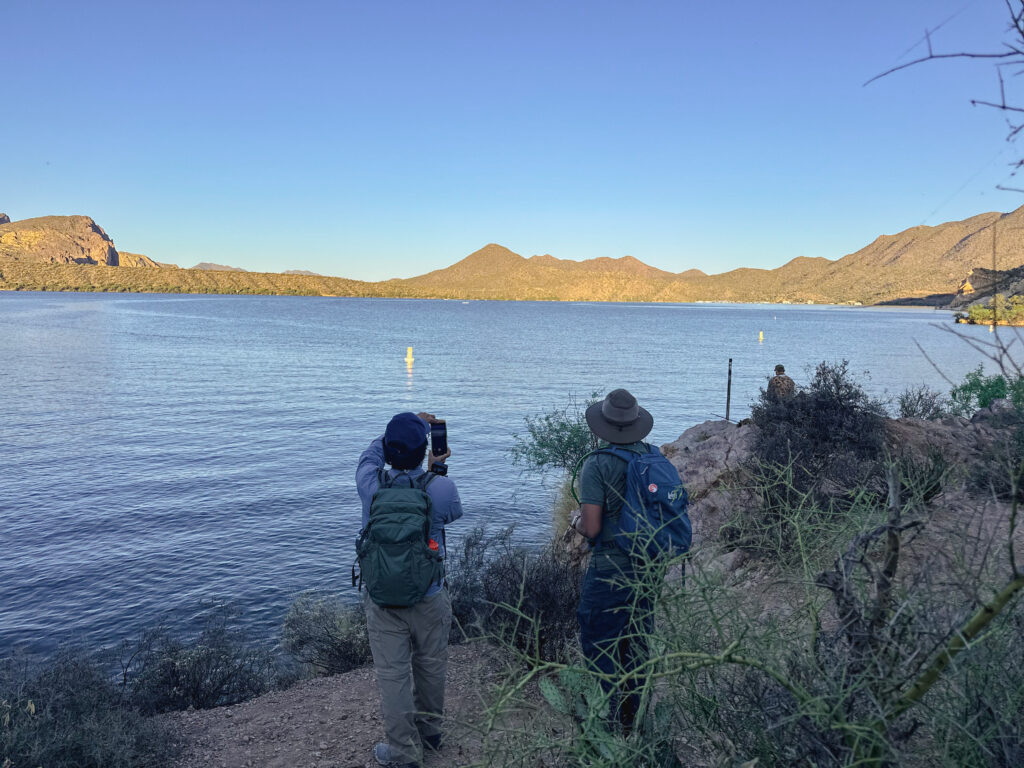
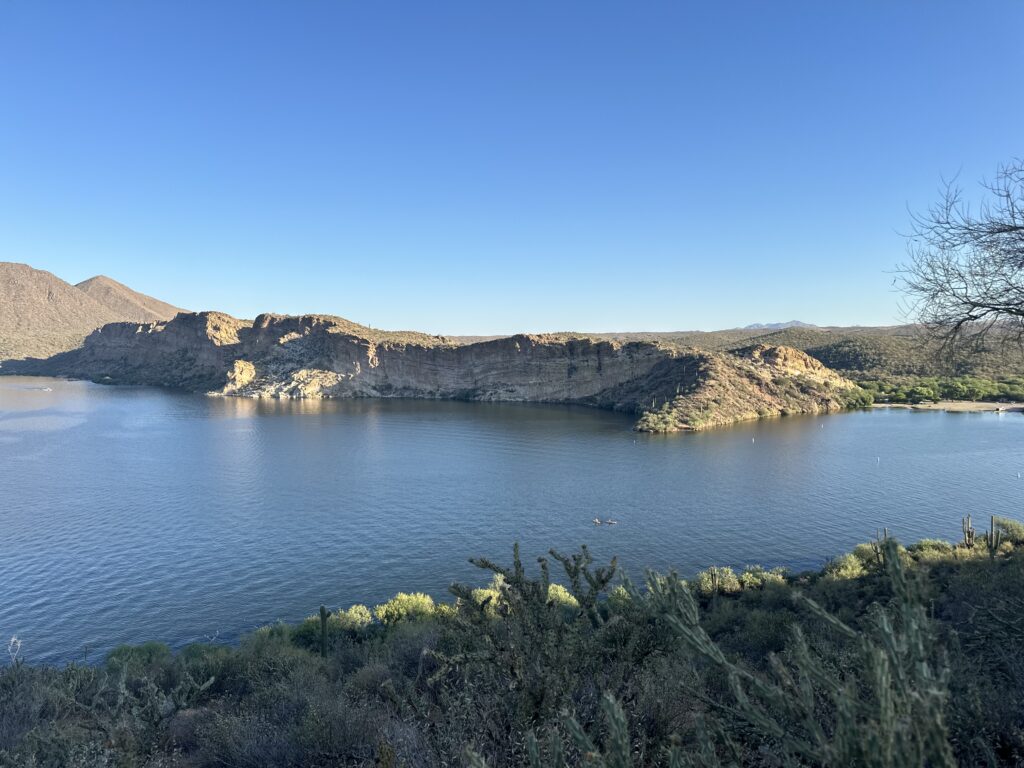
    But here is the thing about this trail. It doesn’t feel like most Phoenix hikes. You walk out expecting the usual, rock, scrub, a ridge, a view if you earn it. Butcher Jones gives you water. A lot of it, and for a long time. The trail follows the Saguaro Lake shoreline, the lake always present alongside you, and then cuts across toward the Salt River arm, another wide open body of water waiting on the other side. Saguaro and Salt River are connected somewhere. We just never saw where.

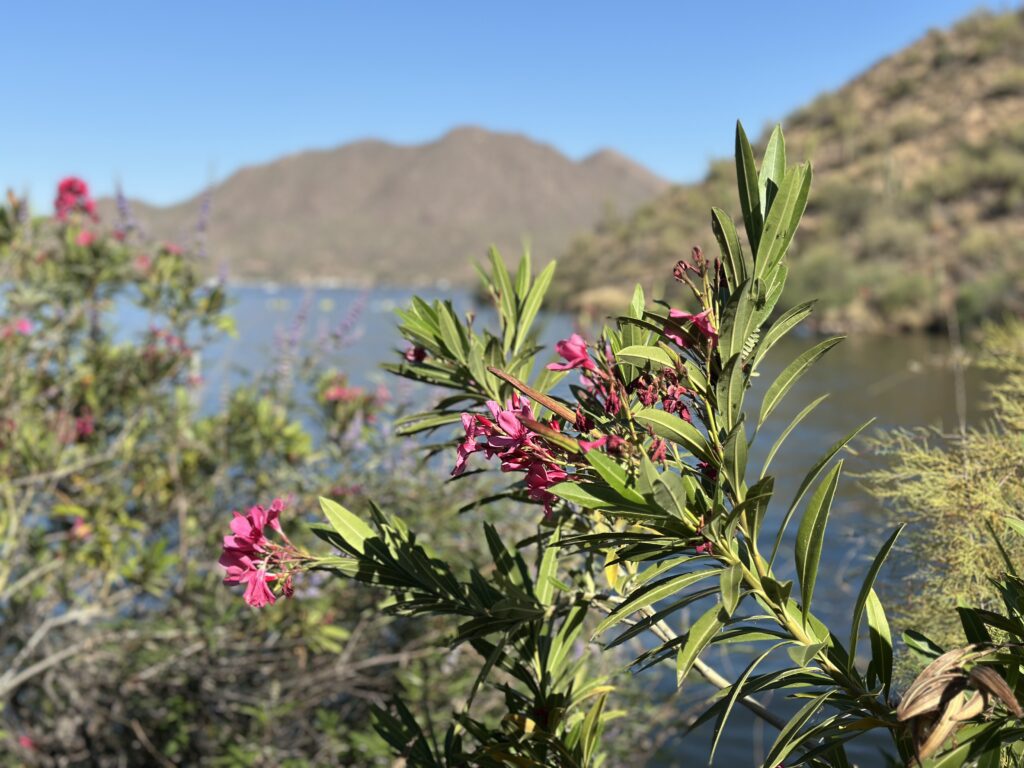
    We found oleander and lilac in bloom near the water. Pink and purple against all that brown and blue. Nobody expected it.

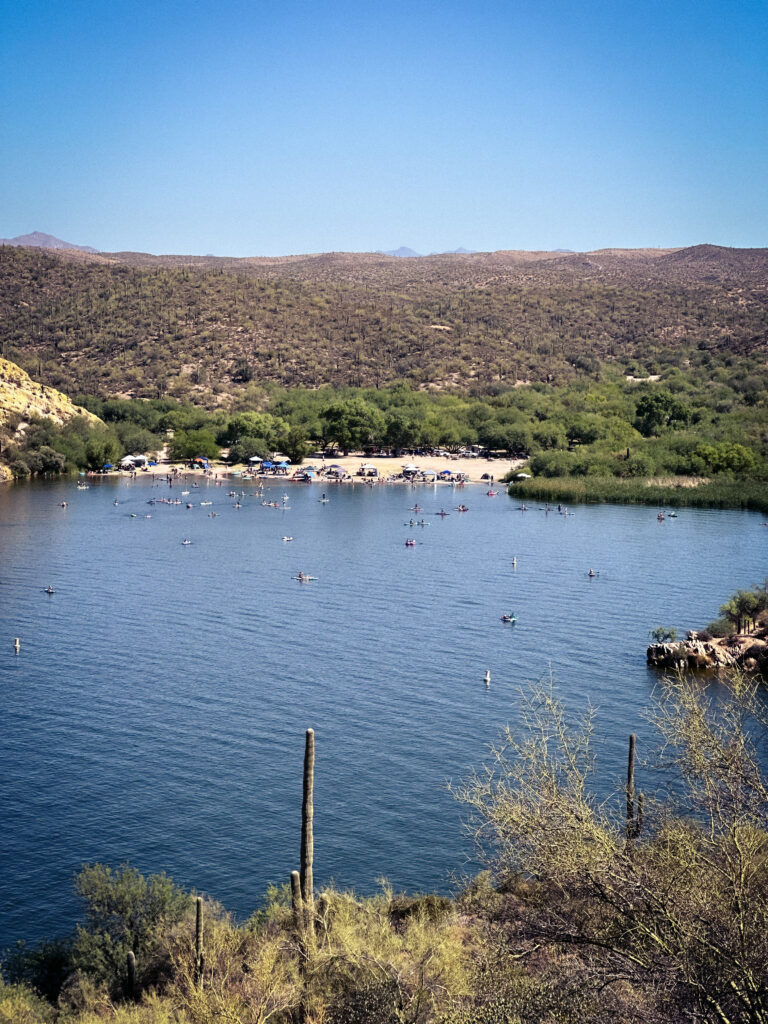
    We started in the quiet. A few people were just beginning to launch their boats as we set off. By the time we came back, the lake had become something else entirely, campers along the shore, paddleboards on the water, a full summer Saturday in progress.

    6.1 miles. Not much elevation. A lot of sky and a lot of water, which in Arizona is its own kind of strenuous.

  • The Detour Was the Point

    We were supposed to start at 5:45 AM. That was the plan. We started at 6:15. That’s just how it goes when a group of adults assembles in a parking lot before sunrise.

    The trail fee was $5. Cash only, drop it in an envelope. Nobody had a pen. Some of us had $10 and no change. We sorted it out the way groups always do: improvisation, mild chaos, and someone eventually finding a solution. Then we started walking.

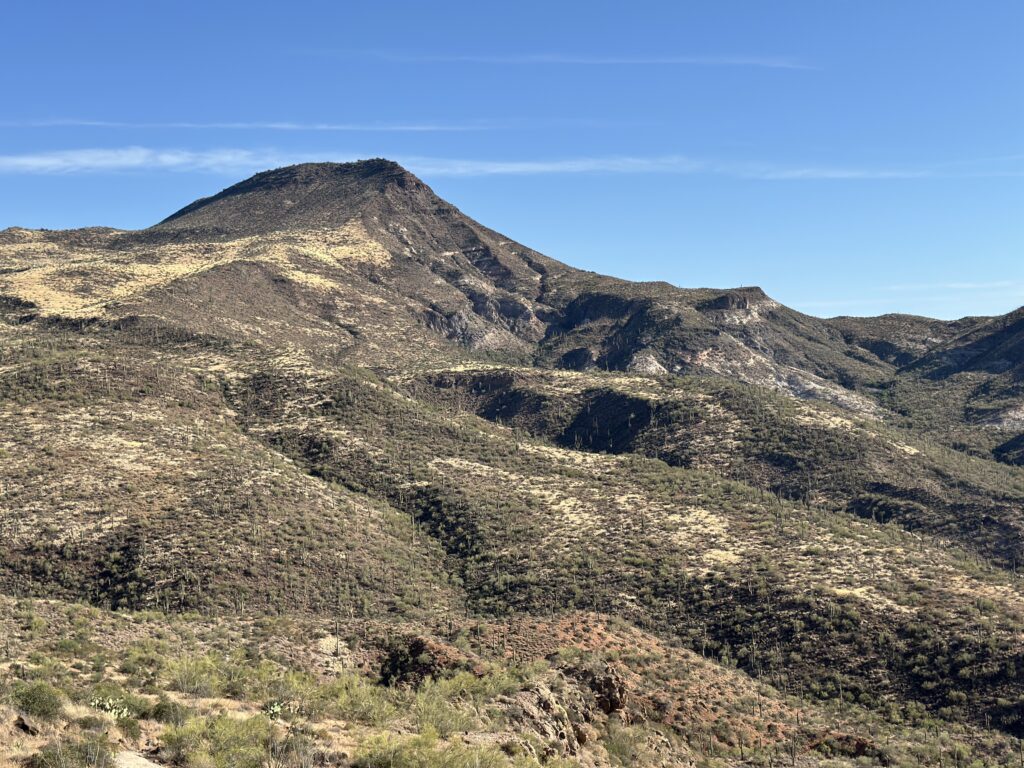
    Elephant Mountain Loop. 7.4 miles, 1,444 feet of elevation gain. I had looked at exactly one thing before signing up: the elevation. That’s my usual filter. Most trails I do are under 4 miles, so I look at how hard the climb is and leave it there. I did not look at the distance. 7.4 miles is nearly double what I normally do. I found this out the hard way.

    The first stretch was manageable. Ascents, yes, but mild ones. The creek crossing came along the way: dry, just rocks and sand, not a drop of water. Somewhere in that stretch the thought crossed my mind: what does this look like in monsoon season? Does it actually flow? How would anyone hike through here with water rushing across the path? The questions came and went as I kept walking.

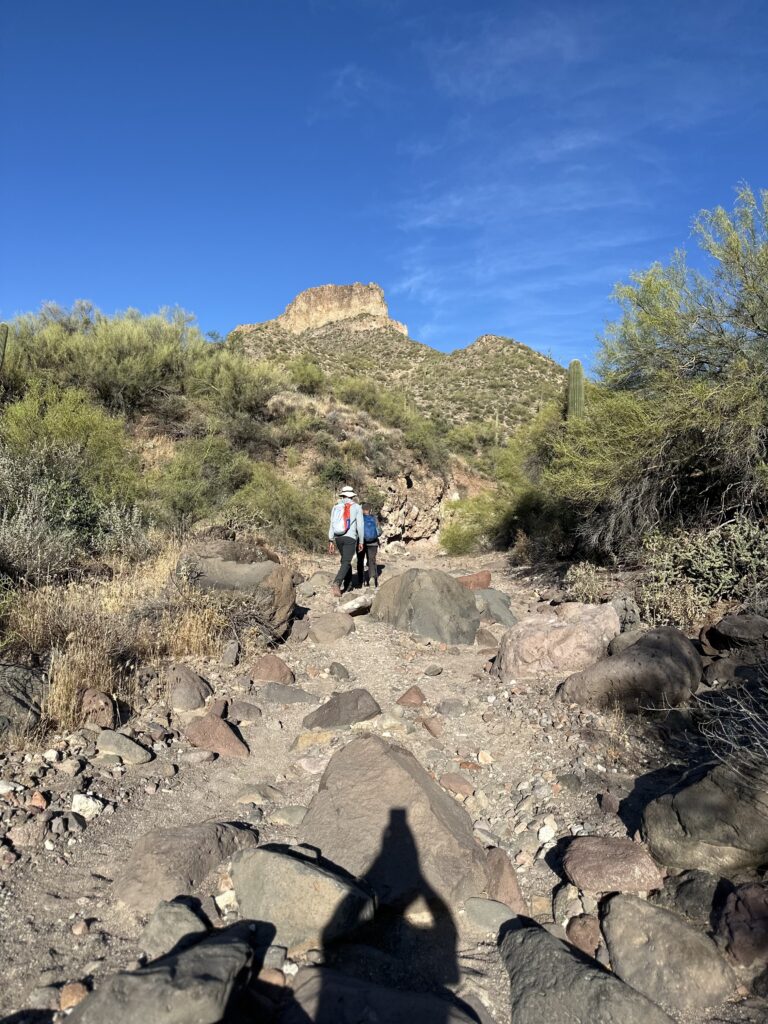
    Then the real climb started. What came before the creek was warmup. What came after was the actual work, the kind of ascent where you stop making conversation and start making deals with yourself about the next hundred feet.

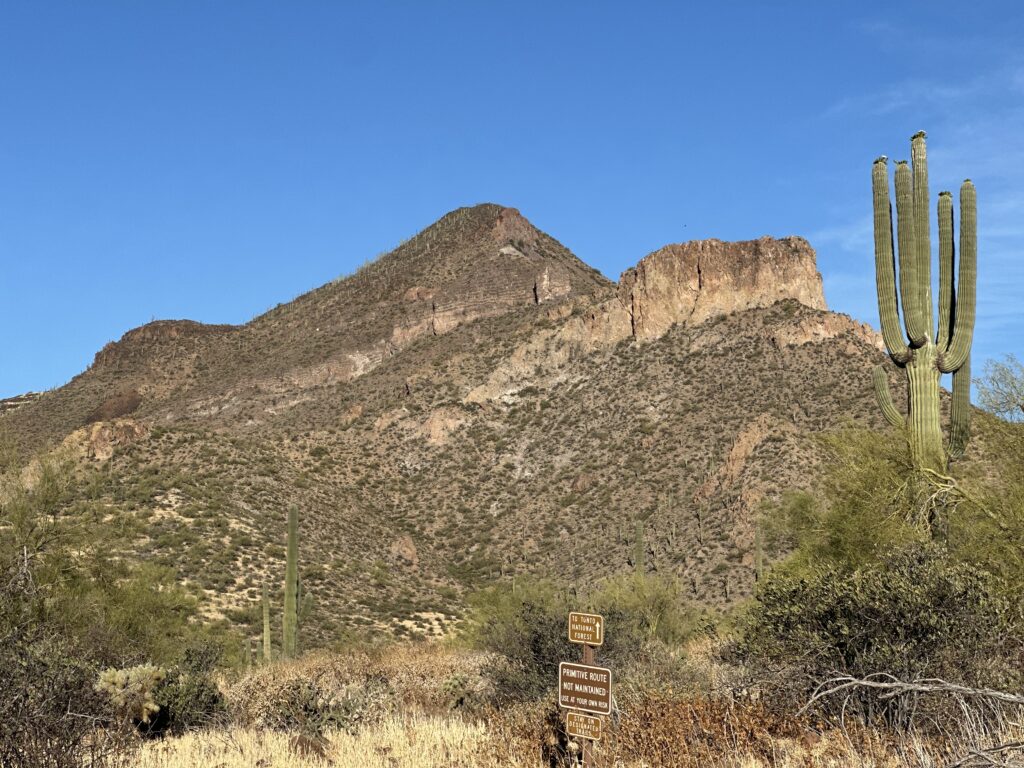
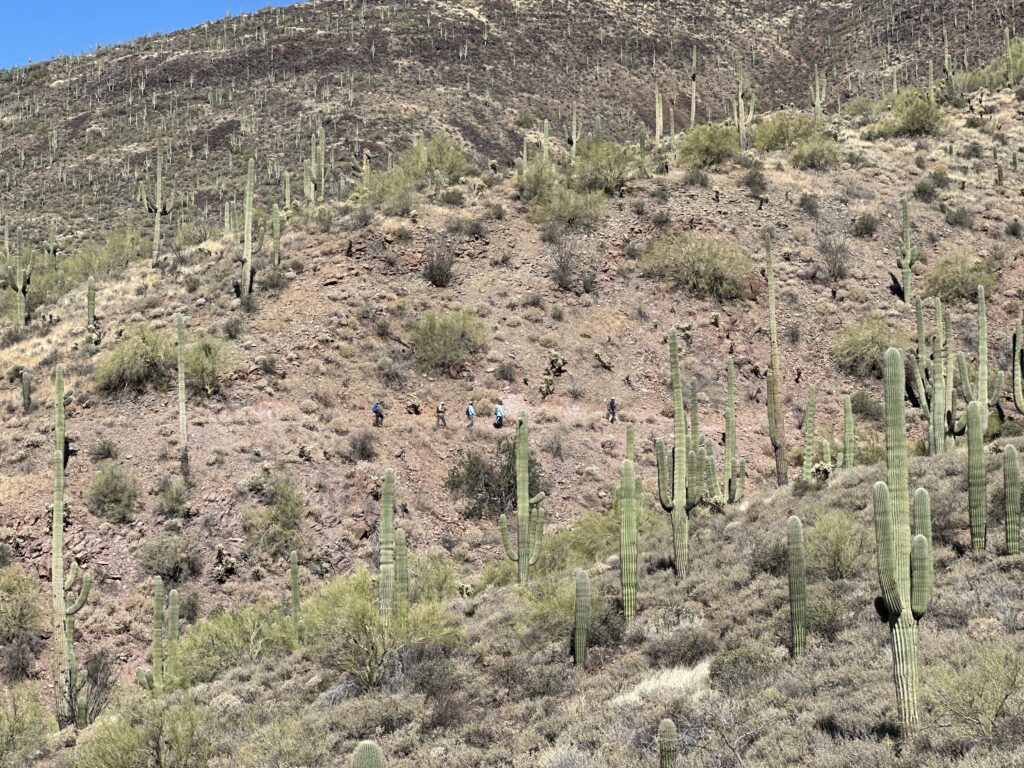
    The saguaros on the slope were doing interesting things in the morning light. One of them had arms going in three different directions, like it had spent a century arguing with itself about which way to grow. I stopped for that one.

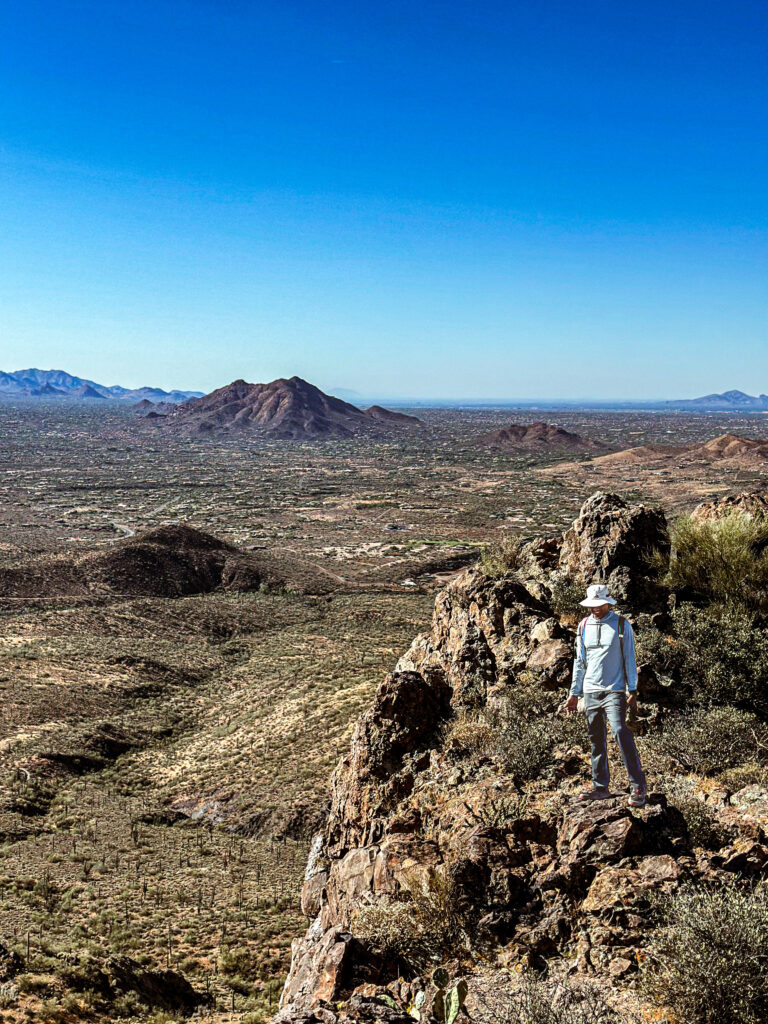
    When we reached the highest point on the trail, someone said we could go a little further. Off trail. Up to the actual peak. There was a sign. The sign said closed.

    We looked at the sign. We looked at the peak. Then we spotted another group already up there, having made the same calculation ahead of us.

    We went.

    The view from up there was the kind that makes the entire morning make sense. The whole valley laid out below, hills receding into haze in every direction, the city a faint suggestion at the edge of the horizon. One of those views where you stop taking pictures for a moment because you realize the camera isn’t going to get it anyway. Then you take the pictures.

    Then someone said we had 4 miles left.

    The way back was different. The group split into three somewhere on the descent. The fast ones ahead, the steady ones behind, me somewhere in the middle with my camera. That’s the thing about long trails. They sort people out eventually. Everyone finds their own pace when the summit is behind them and it’s just distance left to cover.

    I made it back. I drove home. I sat down and discovered that 7.4 miles of desert climbing had done something that months of gym sessions had not managed. It had actually activated my glutes. I have been working on lower body strength all year. Apparently what was needed all along was a closed trail and poor planning.

    The lesson I am taking from this: read the full trail description, not just the elevation. And when someone suggests a detour, go. The detour is usually the point.

  • The Warmth I Assumed Was Mutual

    I am not someone who calls people often.

    But I think about them. Old colleagues from a project that ended years ago. Friends from a city I no longer live in. They show up in my thoughts, sometimes randomly, sometimes when something reminds me of them. I savor the memory. I smile, or I become a little sad. And then I continue with my day.

    No message sent. No call made. Just the feeling, held privately, and then released.

    A friend said something once that stayed with me. We were talking about presence, how being seen creates connection, how absence quietly erodes it. He said it almost in passing.

    Out of sight, out of mind.

    I paused. Turned it over. It was one of those observations that feels obvious the moment you hear it, and yet you had never quite said it to yourself that clearly before.

    Most of us who have moved away from home understand this in a particular way. We left. The relationships we had with parents, with childhood friends, with the people who knew us before we became who we are now, moved to the phone. And the phone is only as good as the calls we make.

    I think of people. But they cannot feel me thinking of them. The warmth I hold privately goes nowhere. It doesn’t arrive. It doesn’t count.

    I hold people in my thoughts like it is a form of tending. It isn’t.

    And then I think about the other side of this. Not what I do to others, but what others may be doing to me. Right now, somewhere, someone is thinking of me. Savoring a memory. Smiling, or becoming a little sad. And doing nothing.

    I just don’t know who.

  • The Layer Nobody Was Looking At

    Sometimes the most consequential problems don’t announce themselves. They show up disguised as routine questions.

    I was in a room once where a pricing conversation had everyone’s attention. A contract model was being renegotiated and the new structure came back more expensive than the existing one. The instinct in the room was immediate: bring the number down. That is a reasonable instinct. Except the existing model had years of hidden costs quietly folded into it. The new structure was pricing something the old one was absorbing invisibly. You cannot compare them directly.

    But the bigger question nobody was asking was why the customer wanted to renegotiate at all if they were already getting a good deal.

    The answer had nothing to do with money. Something had shifted in the relationship. Trust had quietly eroded. The customer was trying to regain control of a narrative that had started to look bad on their side. The new contract structure was not about cost. It was about credibility.

    The room was solving a pricing problem. The real problem was running on a completely different layer.

    Then there was a different conversation. A routine check on a delay. Someone explaining what went wrong. The short version: a chain of people had each done their job correctly against the wrong starting point. By the time the error surfaced, a fix was already underway. Fast, competent, impressive. But in the focus on fixing, one thing had been missed. The people who needed to know, didn’t.

    One question changed the temperature of that conversation: who knows about this?

    The answer revealed the real problem. The fix was on track. The exposure wasn’t. Someone senior was one phone call away from hearing about a problem they had never been told existed. That is a different kind of risk, and it had nothing to do with the technical layer everyone was working on.

    Both situations had something in common. The problem everyone was solving was not the real problem. The real problem was running on a layer nobody was looking at. In the first story it was trust and perception. In the second it was escalation and exposure. Nobody was incompetent. Nobody was malicious. They were solving what they could see.

    Edward de Bono saw the same pattern and built a framework around it. Six thinking hats, structured, deliberate, designed to pull you out of your default perspective. It works. But a framework asks you to stop and think. A layer does not wait. It is already moving while you are in the room. You do not get to call a timeout and put on a hat. You either see it or you don’t.

    The hats teach you to look. Experience teaches you to see.

    I don’t have a checklist for this. I am not sure one exists. But there is one question worth asking quietly, before any move, in any room.

    What am I not seeing right now?

  • The Money They Never Taught Us — Part 5: What We Teach Kids Instead

    Think back to the child running errands. The one sent to the grocery store with a list and exact change. The one who came back with everything accounted for, mission accomplished, having learned nothing about money except how to move it from one hand to another. That child was me. That child was probably you. That child is, in many homes, still being produced today.

    We mean well. That is the part that makes this complicated. The adults who sent us on those runs were not negligent. They were passing down what they had been given. The belief that proximity to transactions teaches financial sense. That counting change builds money wisdom. That carrying the weight of grocery bags somehow prepares a child for the weight of financial decisions. It does not. It never did. It just felt like it should.

    What we actually teach children when we send them on errands is compliance and execution. Go here, buy this, come back with the correct change. These are useful life skills. They are not financial ones. A child who has run a thousand errands still does not know what an asset is. Still does not know why saving a portion of whatever they receive matters. Still does not understand that money left to grow quietly over time becomes something entirely different from money spent the moment it arrives.

    The knowledge is not complicated. We have established that now. Two books, both of them decades old, laid it out plainly enough for anyone to understand. A portion of all you earn is yours to keep. Money has the ability to work for you if you let it. The difference between spending and investing is the difference between a life spent running errands for money and a life where money eventually runs some errands for you.

    This is teachable. It is teachable to children. It does not require a finance degree or a sophisticated vocabulary. It requires someone who knows it to sit down and say it out loud.

    So here is the question I want to leave you with. Not a rhetorical one. A real one. You have children, or you will, or you know some. You now know things about money that nobody taught you when you were young. Things that took you years and two books and a certain amount of quiet frustration to finally understand. What are you going to do with that? What will you teach them? And more importantly, when will you start?

    The errand can wait.

    This is Part 5 of The Money They Never Taught Us. Click here for Part 4. https://nonaspensieve.com/the-money-they-never-taught-us-part-4-the-first-rule/

  • Granny Smith

    I did not know my mother loved sweet things until I was well into adulthood. You would think that growing up in the same house would teach you everything about a person. It does not. Children are too busy growing up to notice the people around them properly.

    It took a fridge to tell me.

    I cannot remember exactly when it was. Sometime after I got married, after the children arrived, during one of those visits home. I opened the fridge looking for something and found a quiet stack of sweets tucked away inside. My mother’s private reserve. Someone pointed it out to me. I might not have even seen it on my own.

    That was the moment I realised. She had always loved sweetness. I had simply never been paying attention.

    Then came the diabetes diagnosis. Late in life, as these things sometimes arrive. And with it, the conversations about what she can eat and what she cannot. About managing levels and making adjustments to a lifetime of preferences.

    I called her recently. Long distance, the way most of our conversations happen now. I had done my research. I knew what I wanted to say.

    I started with the easy ones. The vegetables she could eat freely. The fruits that would not spike her levels. I explained which ones were safe, which ones to avoid, how to think about portions. She listened. Or at least she did not interrupt, which with my mother amounts to the same thing.

    I was feeling confident. I had saved the best for last.

    Granny Smith apples, I told her. Low sugar. Good for blood sugar control. A smart choice.

    She did not pause. She did not consider. She did not ask what a Granny Smith was or where to find one. Before I had finished the sentence she said:
    “It is very sour.”

    That was it. The research. The careful list. The gentle persuasion. All of it met with four words delivered without a moment’s hesitation.

    It is very sour.

    I smiled. In that one quick sentence was everything. A whole life that had chosen sweetness at every turn, now being asked to make peace with sour. And her answer was not angry or resigned. It was just honest. The way only mothers can be.

    I did not push the Granny Smith apple any further that day.